
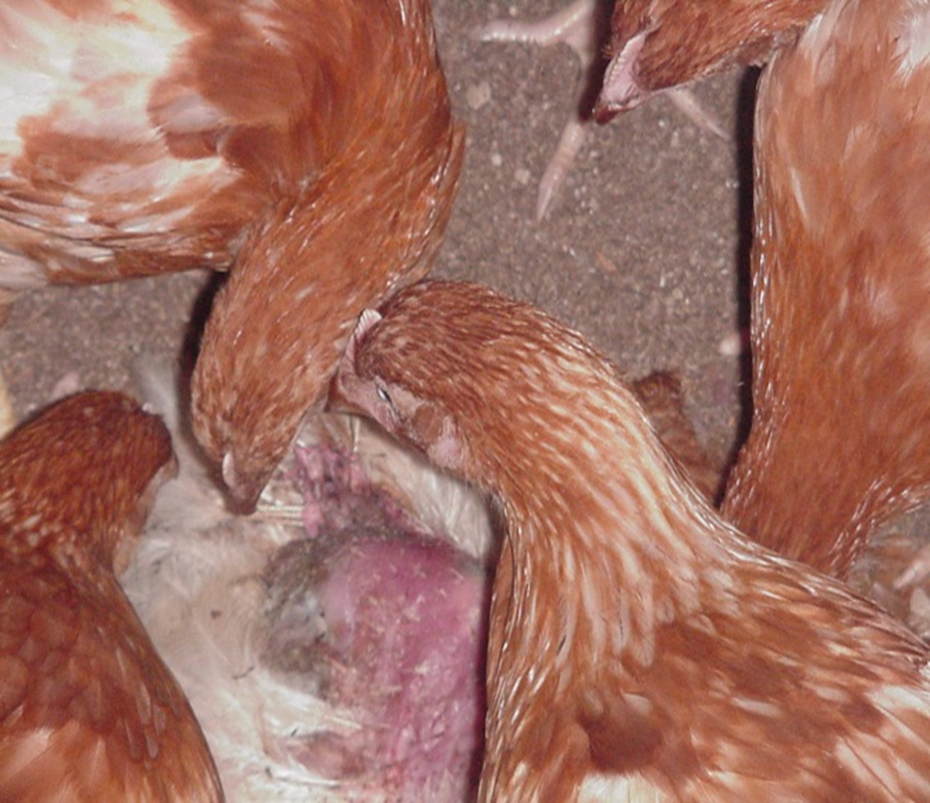
Feather pecking has been a common problem in layer production systems. Cannibalism starts with the pecking of fresh wounds in the back or excretory channels of a hen by nearby birds. As other birds notice this act, they behave similarly. At the beginning, such pecking does not appear to be aggressive in character but to be part of normal feeding behaviour. However, pecking often continues until part of the intestine is obtained. Death follows, usually within a few minutes, but pecking of the corpse continues.
Commercial laying hens are typically fed a highly concentrated energy-dense diet. In natural conditions, hens spend between 50 and 90 per cent of their time foraging, making up to 15000 pecks a day. Hens are still motivated to forage even when provided with adequate feed. Feather pecking is redirected ground pecking behaviour associated with the motivation to forage. Birds reared on a litter type that is attractive for scratching and pecking are less likely to develop cannibalistic behaviour. It is important to provide materials on which birds can practice foraging behaviour, such as straw, green leafy vegetables, or grass clippings. A mash diet may also help prevent outbreaks of cannibalism because the birds take longer to consume their feeds.
In deep litter system, overcrowding leads feather pecking and cannibalism. Failure to provide adequate space for each member of the flock to feed and water can encourage competition that may lead to cannibalism and also cause more-dominant birds to keep others away from feed and water. Having enough feeder space to allow all birds to eat simultaneously also helps prevent birds from becoming underweight since such birds are frequently the victims of cannibalism. The housing system should also provide enough floor space. If perches are available, ensure that they are enough for multiple birds to perch at one time. Birds can escape vent pecking by perching off the ground where hens on the floor cannot reach them.
Overheatingcauses birds to become uncomfortable and prone to pecking. Provide adequate fresh, cool water and proper ventilation for the type and age of the birds in your flock.
Inadequate nutrition can also cause feather pecking. Cannibalism may follow on from feather pecking especially if feed is deficient, but may also arise independently. As chicks grow, their protein requirements change and hence it should be adjusted to suit the requirements of the birds. It is very crucial to provide the birds with a well-balanced diet and an ample supply of water. The diet should be balanced appropriately for the age of hens being raised as illustrated by the table below.
Adequate feeding allowance:
| Day old-8 weeks | Chick Starter Mash | Allow for 2kg of feed per bird during this whole period |
| 8-17 weeks | Growers Mash | Allow for 4.5kg of feed per bird during this whole period |
| 16-19 weeks | Growers Mash mixed with Layers mash (1:1) | Allow for 125g of feed/bird/day during this phase |
| 19 weeks onwards | Layers Mash | Allow for 125g of feed/day/bird during this phase |
Birds routinely preen themselves, using the oil from the preen gland near the tail. The oil from the preen gland has a salty taste. If you feed birds a diet without salt, the birds will overuse the preen gland, resulting in cut feathers. They will then begin to pick at the preen glands of other birds.
Injured or dead birds left in the flockmay enhance cannibalistic behaviour. Chickens are attracted to blood and cannibalism outbreaks can be initiated by the injury of one bird. As a result, it is important to prevent injury. Loose wires on cages and pens should be fixed, as these can puncture the skin and cause bleeding, encouraging pecking by other birds. Cannibalistic chickens, injured birds, victims of cannibalism, and dead birds should immediately be removed from the flock.
Light that is too bright may also enhance feather pecking and cannibalism. Provide light that is of the right intensity.
Adequate light intensity:
| 0-4 days | 20 lux then decrease gradually |
| 5-18 weeks | 5 lux |
| Laying period | 5 lux |
Flocks of Different ages, breeds, colours, or sizes that have not been reared together often upsets the social order of a flock and increases the chances of cannibalism when combined in one pen. Intermingling such birds should be avoided.
Abrupt changes in management practices or the environment can stress birds and lead to aggression. When young birds are being moved to a new location, it is best to move some of their feeders and drinkers with them in order to help them adapt to the new environment. When introducing larger feeders and drinkers, it is helpful to leave the smaller equipment in the pen for a few days to help the birds adjust well to the transition.
Inadequate laying conditionsmay promote cannibalism. Bright lights should not be placed near the nesting areas. A darker nest box gives a hen a safe place to lay eggs, preventing exposure of the everted cloaca which occurs when an egg is laid. Since the cloaca is highly attractive for pecking, some outbreaks of cannibalism begin during egg laying.
In addition, de-beaking is a practice that can be done to lower vices such as feather pecking, vent pecking and cannibalism. This is done at 6-10 days of age and/or repeated at 8-12 weeks if there is need. Provide water soluble vitamins and minerals a few days before de-beaking to eliminate stress and encourage faster healing.
A summary of the corrective measures include the following:
· Remove victims of cannibalism and care for them separately.
· Dim lights.
· Add additional feed and water space.
· Add perches to the housing environment.
· Add more nest boxes (for laying flocks).
· Consider de beaking
· Ensure balanced diets are fed.
· Provide loose feed to encourage ranging and foraging behaviour.
· Ensure birds and housing are free of lice and mites.
· Prevent boredom by providing distractions, such as suspended cabbage greens, in houses and runs
· Avoid stress and sudden changes to routine.