
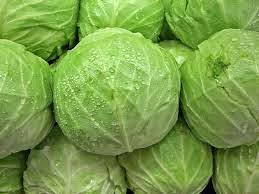
Cabbage is a popular vegetable in Zimbabwe. It will be served at almost every function, be it funeral, party, wedding or any other gathering. Over the years, cabbages have had multiple uses in terms of purpose of consumption. The plant is also used for medicinal purposes to treat gout, stomach problems, deafness, and headache. The entire plant can be cooked or eaten raw as a salad. In Zimbabwe, cabbage has a high market turnover especially in high density areas and city vendor markets. The average selling price is $1 per head. The following is a guide on how to produce cabbages productively and cost-effectively.
Soil and climatic requirements
Cabbage thrives in well-drained, moisture-retentive, loamy soils well supplied with organic matter. It does not grow well in acidic soils. The ideal soil pH ranges from 5.5 to 6.5 and it should not be allowed to drop below 4.5. The optimum temperatures for growth and development are from 18 °C to 20 °C. It is fairly resistant to frost and can survive temperatures as low as –3 °C without damage. Cabbage is also adapted to a wide variety of weather conditions and, hence, can be grown throughout the year in most regions.
Land preparation
The land should be clean-cultivated 8 weeks before planting. The land must be ploughed deeply, immediately before planting, with a disk harrow or other suitable implement to a depth of 450 to 600 mm. The soil should be fumigated 2 weeks before planting to control nematodes.
Planting
Cabbage may be planted by direct seeding or transplanting of seedlings. If direct seeding is to be used, about 2 kg of seed per hectare may be required. Seedlings should be transplanted as soon as they reach the desired size. Only well-hardened, young, stocky plants should be used. Transplanting is done in moist soil. The soil around the roots should be firmed and irrigated as soon as possible after setting the seedlings. In wet areas, cabbage should be planted on raised beds or ridges to reduce waterlogging and stem or root-rot diseases. Plant populations of 40 000 to 45 000 per hectare are suggested for large-headed types while for cultivars with medium-sized heads, populations of 55 000 to 65 000 plants per hectare are said to be ideal. For baby cabbage, populations of 80 000 to 100 000 plants per hectare are recommended. It is recommended that large-headed cultivars should be planted 600 to 700 mm apart between rows and 450 mm apart within rows. Smaller-headed varieties are planted 600 mm between rows and 300 mm within rows. One must note that if growing cabbages from seedbeds to lands, transplanting should be done after the third week. The fertilisation is explained below.
Fertilisation
Fertiliser programmes should be based on soil analyses and should be developed for each field. On seedbeds, we generally recommend 45 g/m2 of basal Windmill Compound S Fertiliser (7:21:7 9S 0.04B). After 2 to 3 weeks of germination, one is recommended to apply Ammonium Nitrate (34.5% N). On lands, we recommend Windmill’s Compound C (5:15:12 11S.1B ) at 600 kg/ha as a basal fertiliser. Other basal fertilizers can be used but ensure that they have Boron. Apply Potassium nitrate (13:0:46) as a top dressing at 250 kg/ha split at 3 and 6 weeks after transplanting.
Irrigation
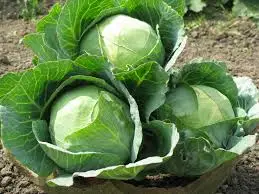
Cabbage should be irrigated immediately after sowing or transplanting. Thereafter, irrigation should be applied at intervals of 10 to 12 days on heavy soils or 8 days on light sandy soils. The irrigation schedule should be followed until the heads are fully developed and firm. Young plants should receive enough water for vegetative growth before forming heads. Excess moisture when the heads have formed may cause them to crack.
Weed Control
Weeds are controlled mechanically or by hand as well as chemically by applying registered herbicides. Mechanical cultivation should be done during land preparation until the plants are about half-grown. The first cultivation should be done 2 to 3 weeks after transplanting. Below is a list of recommended herbicides:
| Weed Problem | Product remedy |
| Grasses and some broadleaf weeds | Lasso/Alachlor 480 EC, Ronstar 25 EC. |
| Grasses only and Shamva grass | Agil 100 EC/ Propaquizafop. |
| All green matter and weeds | Agriquat/ Gramoxone/ Paraquat 20 SL. |
Pest Control
Common pests that attack cabbage are aphids, diamond back moth, Bagrada bug, American bollworm, cabbage webworm, greater cabbage moth, red spider mite, cutworms, Plusia looper, thrips, and nematodes. Control can be achieved by practicing crop rotation. Always try to keep the field clean and free of weeds as they serve as hosts for many pests. Below is a list of recommended insecticides:
| Problem Pests | Product remedy |
| Aphids | Dimethoate 40 EC and Malathion 25 WP. |
| Cutworm | Dursban/ Pyrinex 48 EC, Fenveralate, Lamda-Cychlothrin 5 EC . |
| Diamond back moth | Malathion 25 WP, Dedevap 100 EC, Cartap hydrochloride/Suntap, Match 50 EC/Lufenuron. |
| Hoppers/ Loopers and Crickets | Carbaryl 85 WP, Dipterex 95 SP, Thionex 50 WP. |
Disease Control
Common diseases include: damping off, Sclerotonia rot or white mould, clubroot, Fusarium wilt or cabbage yellows, black leg, downy mildew, black rot and bacterial and leaf spot. Control can be achieved through chemical means, planting tolerant or resistant. Below is a table of recommended Fungicides.
| Problem diseases | Product remedy |
| Downy mildew | Copper Oxychloride 85 WP, and Dithane M45 |
| Damping Off | Thiram 80 WP |
Harvesting and Storage
Yields will vary with the season of production, variety, and production system used. With proper management, cabbage can produce 10 to 12 tons per hectare. Growers in first world countries such as the United States of America have produced upwards of 16 to 20 tons per hectare. Generally, most markets prefer heads that average 1 kg. Some varieties of cabbage mature uniformly, requiring one to two harvests. Others can require three or more pickings to complete harvesting. When harvesting, cut stems close to the ground near the base of the head. Be sure that heads are well formed and firm. Typically, outer wrapper leaves are removed. Once cut, remove cabbage from direct sunlight because cabbage wilts quickly when exposed to sunlight. Wilting results from a loss of water from the head. Cool cabbage to 4-10°C before shipping it. This will increase shelf life and reduce the development of rot diseases. In cold storage, cabbage can be stored at 3-9 °C at 98 to 100 percent relative humidity for up to 6 months.
For more details please contact the following:
Dr Lawrence Gono Head of Agronomy gono@windmill.co.zw
Tawanda Hove Marketing hove@windmill.co.zw