

Pepper is popular in Zimbabwe especially as an additive to gravy/soups or relishes. Peppers generally are sold through the retail markets although they can be found at open vegetable markets. Wholesale buyers include Favco, Selby, and Willowvale wholesale amongst a host of retailers who also pack and resell the crop. The most popular types of peppers in the market are green and red peppers. Peppers are not difficult to grow but must not be planted in frost-prone regions. This production guideline provides growers with information on how best to grow peppers.
Cultivars
Peppers that are frequently grown are varieties of C. frutescens, which are the peppers commonly grown in the vegetable garden and include those from which red pepper, cayenne pepper, tabasco, and paprika are made. There are many varieties of garden peppers. They are divided into two main groups: the sweet peppers or mild-flavoured varieties, which are used for stuffing, salads, and garnishing; and the hot peppers, which are mainly used in sauces and flavouring. The Spanish word “Chili” describes peppers of all kinds, but in English, the name is usually only applied to the pungent varieties used for flavouring. C. frutescens grossum, the sweet or bell pepper, is a popular vegetable. Certain types of peppers are very beautiful when grown as potted plants, especially in the late summer and early winter. The best are C. frutescens cerasiforme, the cherry pepper and C. frutescens conoides, the cone pepper. The varieties of these kinds have red, purple or cream-coloured fruit.
Climatic requirements
Pepper is a warm-season crop, which performs well under an extended frost-free season, with the potential of producing high yields of outstanding quality. It is very vulnerable to frost and grows poorly at temperatures between 5 and 15 °C. The optimum temperature range for sweet pepper is 20 to 25 °C. The germination of pepper seed is slow if sown too early when soil temperatures are still too low, but seedling emergence accelerates as temperature increases to between 24 and 30 °C. The optimum soil temperature for germination is 29 °C. Low temperatures also slow down seedling growth, which leads to prolonged seedling exposure to insects, diseases, salt injury or soil crusting, any of which can severely damage or kill off the seedlings.
High temperatures adversely affect the productivity of many plant species including green pepper. Sweet pepper requires optimum day/night temperatures of 25/21 °C during flowering. The exposure of flowers to temperatures as high as 33 °C for longer than 120 hours leads to flower abscission and reduced yields. Pollen exposed to high temperatures (>33 °C) normally becomes non-viable and appears to be deformed, empty and clumped. Temperatures lower than 16 °C can lead to fruitless plants. Higher yields are obtained when daily air temperature ranges between 18 and 32 °C during fruit set. Persistently high relative humidity and temperatures above 35 °C reduce fruit set. Fruit that is formed during high-temperature conditions is normally deformed. Sweet peppers are also very sensitive to sunscald. Fruit colour development is hastened by temperatures above 21°C.
Soil requirements
Bell peppers prefer deep, fertile, well-drained soils. Avoid planting in low-lying fields next to streams and rivers because these sites are subject to high humidity and moisture conditions and, therefore, especially prone to bacterial spot diseases. Producers should also avoid fields where long residual corn or soya bean herbicides have been used because herbicide carry-over can cause serious damage to peppers. Pepper fields should be located as far away from tobacco plantings as possible owing to potential spread of aphid-transmitted viruses from tobacco to peppers. It is also advisable not to grow peppers after other solanaceous crops (such as tobacco, tomatoes, potatoes, and brinjals) or vine crops for a period of three years because all of these crops are susceptible to the same diseases. Peppers do extremely well following fescue sod. Use a soil test to determine fertiliser and liming requirements. Peppers grow best at soil pH between 6.0 and 7.0. Adjust the soil pH to near neutrall (pH 5.5-6.0) for maximum yields. To reduce the risk of Verticillium wilt and other diseases, avoid using fields in your rotation in which egg-plant, tomato, pepper, potato, and strawberry, or caneberry have been planted.
Land preparation
Avoid growing peppers on the same soil more often than once in 3 or 4 years. As tomatoes and peppers are subject to the same diseases, neither should follow the other in successive seasons in the same soil. Soil used for plant beds should have had no peppers grown in it for 4 or 5 years, preferably never before.
Planting
Greenhouse peppers are sown in October through February for harvest of fruit approximately five months later in March through July.
The exact time to maturity varies depending on the variety of pepper. Most sweet peppers mature in 60 to 90 days after planting; hot peppers can take up to 150 days. Keep in mind, however, that the number of days to maturity stated on the seed packet refers to the days after transplanting until the plant produces a full-sized fruit.
Spacing
Although much of the greater part of the total area of all kinds of peppers is grown from transplants, seed can also be sown directly in the open field, principally in some of the warmest parts of the country. Ten to 12 seeds can be planted 45 cm apart on rows that are 75 cm apart and later thinned to 2 plants per stand when 8 to 10 cm tall. One hectare requires 100 to 200 g of seeds. The costs of production by direct sowing are nearly the same as those by transplanting, because of the cost of more seed, thinning, and additional cultivation to control weeds. Direct sowing is not generally recommended, even in places where the season is long enough to permit its use. The seedbed for raising seedlings is made 120 to 150 cm wide and as long as is necessary. The soil is pulverised by forking and breaking up the clods and removing stones and straw.
Fertilisation
Windmill’s basal fertiliser Super C (6:24:20 8S 0.1B) should be applied at a rate of 500 kg per hectare at planting. At 5, 10 and 14 weeks after transplanting, apply as top dressing 200 kg/ha of Ammonium Nitrate, 150 kg/ha of Muriate of Potash, 300 kg/ha of compound J (14:6:20), and 100 kg/ha of Calcium Nitrate.
Irrigation
Many growers of fresh-market peppers plant the crop under black plastic mulch with trickle irrigation under the plastic. This provides uniform moisture and fertilisation during the growing season. Dry conditions result in premature small-sized fruit set, which leads to reduced yields. Sweet peppers have a total water requirement of about 600 mm and a weekly water requirement of 25 mm during the first five weeks and 35 mm thereafter. Excessive rainfall or water supply can negatively affect flower and fruit formation and eventually lead to fruit rot. Unrestricted water supply to the crop can be as harmful as inadequate water. Root rot diseases can be caused by waterlogged conditions that last for more than 12 hours. Therefore, drainage of the field is very important. If plant growth is slowed by water stress during flowering, flowers and immature fruit are likely to drop off.
Irrigation is essential in arid and semi-arid regions to provide enough water for pepper production. Furrow irrigation is well known as a major factor favouring conditions leading to the development of diseases like bacterial wilt. Drip irrigation is one method of water application that optimises water supply for pepper production and conserves water in arid regions. Drip irrigation with cultural practices like mulching generally leads to additional yield increases. Drip irrigation allows for frequent application of low levels of soluble nutrients to the root zone (fertigation). The control over the root environment with drip irrigation is a major advantage over other irrigation systems. Sprinkler irrigation requires good quality water. However, this type of irrigation is likely to make bacterial diseases more of a problem through splashing.
Weed control
Good weed control in peppers should start before the crop is planted. Control established perennial weeds before planting peppers in the field. Use cultural, mechanical, and chemical weed control techniques in a coordinated manner to reduce the risk of interference with the crop. Plastic and organic mulches control weeds effectively. Higher plant density can also smother weeds. Shallow cultivation will help to avoid root damage especially around young plants. Weeds growing up through the planting holes of plastic mulch can be a particular problem. Recommended herbicides include Command 4EC, and Paraquat/Agriquat. For Nustedge control , apply Basagran 480 EC.
Pest control
Aphids
Aphidscan make pepper fruit unmarketable because of the honeydew that is secreted by the aphid and/or associated sooty mould fungi. Infested plants can be stunted, with deformed foliage. Green peach aphids are variable in colour and have a wide host range. Aphids overwinter as eggs on crop residue or host plants. The winged forms which are less frequently found than wingless forms, enable the insect to move into new areas. Females can reproduce without mating with males. Aphids are generally most abundant from mid-summer through October. Their severity is greatly influenced by weather patterns.
Greenhouse infestations of transplants can be minimised by practising good greenhouse sanitation. Controlling weed hosts around the edges of fields may help to control aphid infestations. Crop debris should be destroyed as soon as possible soon after harvest.
European corn borer
European corn borer larvae tunnel into and feed on fruit, causing direct damage, premature ripening, and entry points for fruit-rot pathogens. Infested fruit may appear unaffected on the outside but are damaged internally. Cultural control is achieved by locating pepper fields as far away as possible from maize fields. Eliminating weeds around field edges will make pepper fields less attractive to ovi-positing females. Post-harvest control practices include destruction of pepper residues and ploughing in the fall to destroy overwintering larvae.
Mites
Mite feeding damage is expressed as downward curling of leaves, giving an inverted spoon shape and suppression of lamina development of young leaves, and causing the leaves to become narrow. Affected leaves develop a bronze appearance, especially on the lower side, and they become thickened and brittle. Heavy infestations may kill off the apical meristems. Fruit develop a rusted, corky surfaces and may be distorted. Weeds, e.g. nightshade that serve as hosts for the mites, should be controlled to reduce infestation. Several insecticides provide effective control of mites. The recommended chemical control is Imidacloprid 200SL.
Thrips
Thrips damage includes distortion and upward curling of leaves, developing a boat-shaped appearance. The leaves become crinkled and the lamina may be reduced, resulting in narrow leaves. The lower surface of the leaves develops a silvery sheen that later turns bronze, especially near the veins. Damaged fruit is distorted with a network of rusted streaks. Control measures include the use of resistant cultivars and mulching with plastic. Apply Fenveralate 20 EC, Lambda 5 EC, Thionex 50 WP, or Decis 2.5 EC to controlthrips.
Cutworms
Cutworms can be contolled with Decis 2.5 EC, Fenveralate 20 EC, or Lambda-Cyhalothrin 5 EC.
Disease control
Bacterial leaf spot (Xanthomonas campestris pv. vesicatoria)
Bacterial leaf spot is the most economically significant disease of peppers. The causal bacterium infects both pepper foliage and fruit. Leaf spots first appear on the undersides of leaves as small, irregular, water soaked areas. The spots grow large, become purplish-grey with black centres, and may have a narrow, yellow halo. Affected leaves become ragged, turn yellow and drop off. Spots on fruit are like blisters, becoming rough and cankerous and often extending into the seed cavity, predisposing the fruit to secondary pathogens. Loss of foliage also predisposes the fruit to sunscald. An increasing number of resistant varieties with good horticultural characteristics are becoming available to producers. Also practise a two-year rotation away from tomato and pepper crops.
Seed should be certified and disease-free. A seed treatment using bleach may help provide control. Good field sanitation should be practised to minimise the spread of the disease. Planting disease-free transplants is a key step in managing this disease in the field. Most growers have switched from overhead irrigation to drip irrigation in part to minimise the spread of Bacterial leaf spot (BLS). Crop debris should be destroyed as soon as possible soon after harvest to prevent disease carry-over to other plants and to initiate decomposition. Apply Copper Oxychloride 85% WP to control Bacterial leaf spot.
Powdery mildew
The symptoms are chlorotic spots on the upper leaf surface. Numerous lesions may coalesce, causing chlorosis of the leaves. Lower leaf surface lesions develop a necrotic flecking and generally, but not always, are covered with a white to grey powdery growth. It progresses from older to younger leaves, and leaf shedding is a prominent symptom. The disease is promoted by warm weather (dry and humid). Fungicides are used to manage the disorder. Wettable Sulphur, Benomyl 50 WP, Nimrod, or Shavit 25 EC are all effective remedies.
Anthracnose
Anthracnose can be controlled with Dithane M 45 or Copper Oxychloride 85 WP.
Physiological disorders
· Blossom-end rot
Blossom-end rot (BER) is a common disorder of greenhouse peppers, with the symptoms occurring in the pepper fruit. The disorder is associated with a number of environmental stresses as well as calcium deficiency. Any condition which causes water stress or a reduction in transpiration, and resultant movement of nutrients through the plants can cause symptoms to develop. Lack of water, fluctuating soil water conditions, damage to the root system, and high electrical conductivity in the root zone can cause blossom-end rot. An actual calcium deficiency to the plant is rarely the primary cause of the disorder as BER can develop when adequate levels of calcium are being fed to the plants. The environmental factors that can trigger the disorder interfere with the movement of calcium within the plant, causing less calcium to reach the fruit. Some cultivars are more prone to this disorder than others.
Symptoms of blossom end-rot begin as soft spots on the fruit, which develop into sunken, brownish to tan lesions with a very distinct border between affected and healthy tissue. The spots usually occur on the bottom third of the fruit and are not strictly confined to the bottom, or blossom end of the fruit. Affected fruit is unmarketable. Control is obtained by avoiding conditions of moisture stress or conditions of reduced transpiration in the crop. Simply ensure that the plants receive adequate water and that the vapour pressure deficits (VPD) targets are met. Weekly foliar applications of calcium nitrate can have a significant impact on reducing the occurrence of BER. Apply Calcimax foliar sprays to correct calcium deficiencies.
· Fruit cracks
This condition is characterised by the appearance of very fine, superficial cracks on the surface of the pepper fruit, which gives a rough texture to the fruit. The development of these cracks is associated with sudden changes in the growth rate of the individual fruit. The appearance of fruit cracks can follow periods of high relative humidity (over 85%), changes from hot, sunny weather to cool, cloudy weather or vice versa. Maintaining a consistent, optimised growing environment is the best way to prevent the development of fruit cracks.
· Fruit splitting
The development of large cracks in the fruit is a direct response to high root pressure. Factors that contribute to the development of high root pressure directly impact on fruit splitting. Ensure that optimal vapour pressure deficit (VPD) targets are met at all times. Adjust the timing of the last watering in the day so as not to water too late. Eliminate any night-watering cycles.
· Fruit spots
The appearance of small, white dots below the surface of the pepper fruit is associated with excess calcium levels in the fruit and the subsequent formation of calcium oxalate crystals . Conditions that promote high root pressure will also favour the development of fruit spots.
· Misshapen fruit
The development of misshapen fruit is generally associated with suboptimal growing conditions at flowering and pollination, which result in poor flower development or poor pollination. Ensure that optimal environmental conditions are met and maintained to reduce or eliminate the development of misshapen fruit.
Harvesting
Yields of 6 to 10 ton/ha of bell peppers may be obtained for processing. Fresh market yields may range from 500 to 1 000 cartons (12 kg) per hectare. When using appropriate plastic culture techniques, yields of 1 428 cartons (12 kg) per hectare have been reported. Pimiento and dried chilli pepper yields range from 1 to 2 ton/ha. Pepper yields are greatly influenced by the number of harvests and season. As peppers mature, their walls thicken. Pick peppers when the fruit is firm and well coloured. In some areas, bell peppers are generally hand harvested as green mature fruit. For the fresh market, or when the fruit is to be stored, peppers should be cut cleanly from the plant, using a hand clipper or sharp knife, leaving about a 2 cm section of the pedicel (stem) attached to the fruit. A clean cut is important as such cut surfaces heal more quickly. This reduces incidence of decay in storage and during transport to the market. Care should also be exercised to ensure that the stems do not cause puncture wounds in harvested fruit.
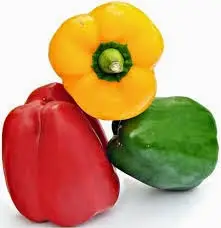
Maturity is determined when the fruit is smooth and firm to the touch (it is a function of wall thickness). Bell peppers for the fresh market must also be 8 cm in diameter and not less than 9 cm long. They can also be harvested red, which are considerably sweeter and more flavourful. Mature yellow, orange and purple bell peppers, together with red bell peppers represent a generally high-value product in fresh market channels. Cherry peppers are machine harvested most successfully. Cherry types are harvested as both green and red fruit and the banana types are generally harvested as yellow, mature peppers. Jalapeño and some cherry peppers have been machine-harvested successfully in other areas. Machine harvesting may be successful with other types, especially where the peppers are intended for processing.
Harvesting MethodsPeppers are generally broken off from the plants with the stems left attached to the fruit. For sweet peppers, strong cloth picking bags which are suspended from the shoulders of the pickers are preferable to baskets or boxes. This frees both hands for rapid and careful removal of the fruit from the plants. Picking in containers that have hard and rough surfaces may result in damage to the peppers.
For more details please contact
Head of Agronomy Dr L.T Gono gono@windmill.co.zw
Marketing Tawanda M Hove hove@windmill.co.zw